


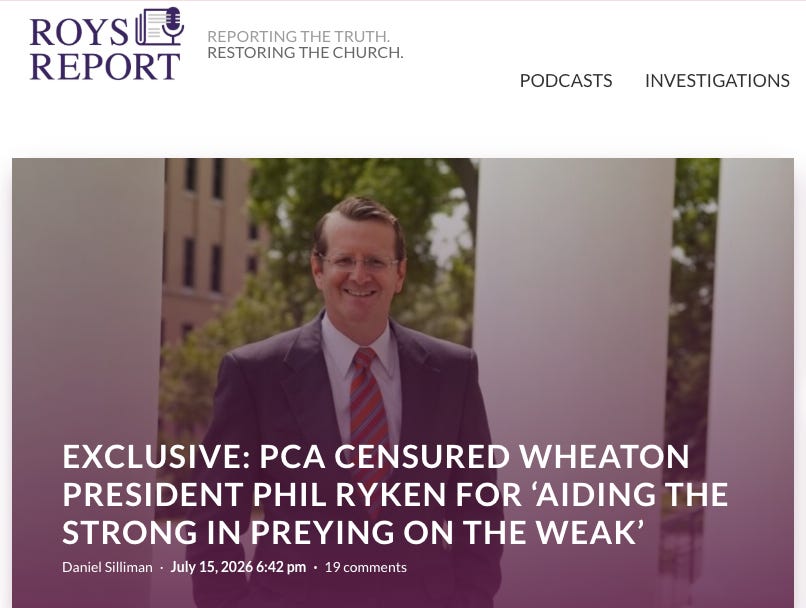
This week, I read Daniel Silliman’s latest reporting on Wheaton President Phil Ryken’s history at Tenth Presbyterian Church. This follows Julie Roys’ series reporting on Wheaton’s failed response to allegations of abuse.
There are many things to say about these events. I’m a Wheaton alum, and I’m angry to see another evangelical institution of my youth incapable of finding the will and moral courage to act with integrity. I’m also a mother to six, with college-aged sons, so when I think of the devastating betrayal experienced by these teenagers who were abused by ministers and people in spiritual authority, I think of the idealism of young adulthood, the admiration for trusted leaders, the wide-open future of my sons, and what it means for an abuser to exploit and crush and consume that.
I was a zealous undergrad, and my years at Wheaton overlapped with Dennis Massaro’s tenure as director of the Office of Christian Outreach. I remember well the spiritual intensity of the OCO, the earnestness we all carried as we bussed into the city to visit the sick or spend time with refugees or gathered to pray. I remember faces and names and try to make sense of that work happening simultaneously with Massaro’s predatory abuse. There are not enough words of lament in the psalter to capture the collective howl of angry mothers and injured children and broken men and the way the sins we do and the sins done to us fracture the world.
I’m Angry About Sin
Occasionally, readers of The Myth of Good Christian Parenting will write reviews expressing concern over my doctrinal stances, typically because our book (1) briefly names penal substitutionary atonement (PSA) as one of many theories of atonement and (2) observes the way ideas about original sin have varied over time and across church traditions. They wonder if I am still orthodox in my belief, if I’ve given up on the idea of original sin, a query that never fails to astonish me. I don’t think anyone could live long in a world that groans and weeps and not conclude that things are not how they are supposed to be. When I see generational cycles of sin, when ministers who proclaim the Gospel and compose hymns can also target teenage boys and abuse their bodies and souls, when upstanding evangelical college presidents who have done many good things can also turn a blind eye and excuse their passivity, when Christian teaching and Christian communities and Christian families and Christian leaders enable all kinds of egregious abuse . . . I recognize the identifiable markers of original sin—the way we cannot extricate ourselves from it, whether we be victim or victimizer or both.
Part of the reason I personally find penal substitutionary atonement to be so uncompelling is it has no answer for this. Here we all are, lost in the ruins of unspeakable devastation, desperate for a Savior, someone to rescue us out of this collective body of death. And PSA offers us a vision of a God consumed not with restoration and shalom but with punishment, as though we all haven’t already tasted firsthand the bitterness of sin and death in one way or another, as though God needs someone, anyone, to experience more pain so that He can feel okay. It’s such an anti-Christ take to me, and I can’t unsee it after becoming a parent myself.
The Myth of Good Christian Parenting has a chapter on sin and a chapter on spanking, because these overlapping concepts are writ large in popular evangelical parenting teaching. I call the resulting practice “liturgized spanking,” because it often comes with direct spiritual catechesis. For instance Tedd Tripp, author of the best-selling book Shepherding a Child’s Heart, outlines the typical formula for “biblical” discipline: Go to a private place, explain how the child disobeyed, indicate spanking will happen, remind them about God and sin, tell them how many swats, take off their underclothes and spank them, offer hugs and prayers (chapter 15). This stuff is everywhere in the Christian parenting books of the past fifty years, and I’ve written at length about it.
I’m Angry About Abuse
But it doesn’t take my years of research to recognize liturgized spanking in Silliman’s article. He interviewed a man who recounted the abuse he experienced at the hands of Paul Jones, a music minister who, as Silliman reports, “trained in Toronto’s Royal Conservatory and composed hundreds of pieces of sacred music.”
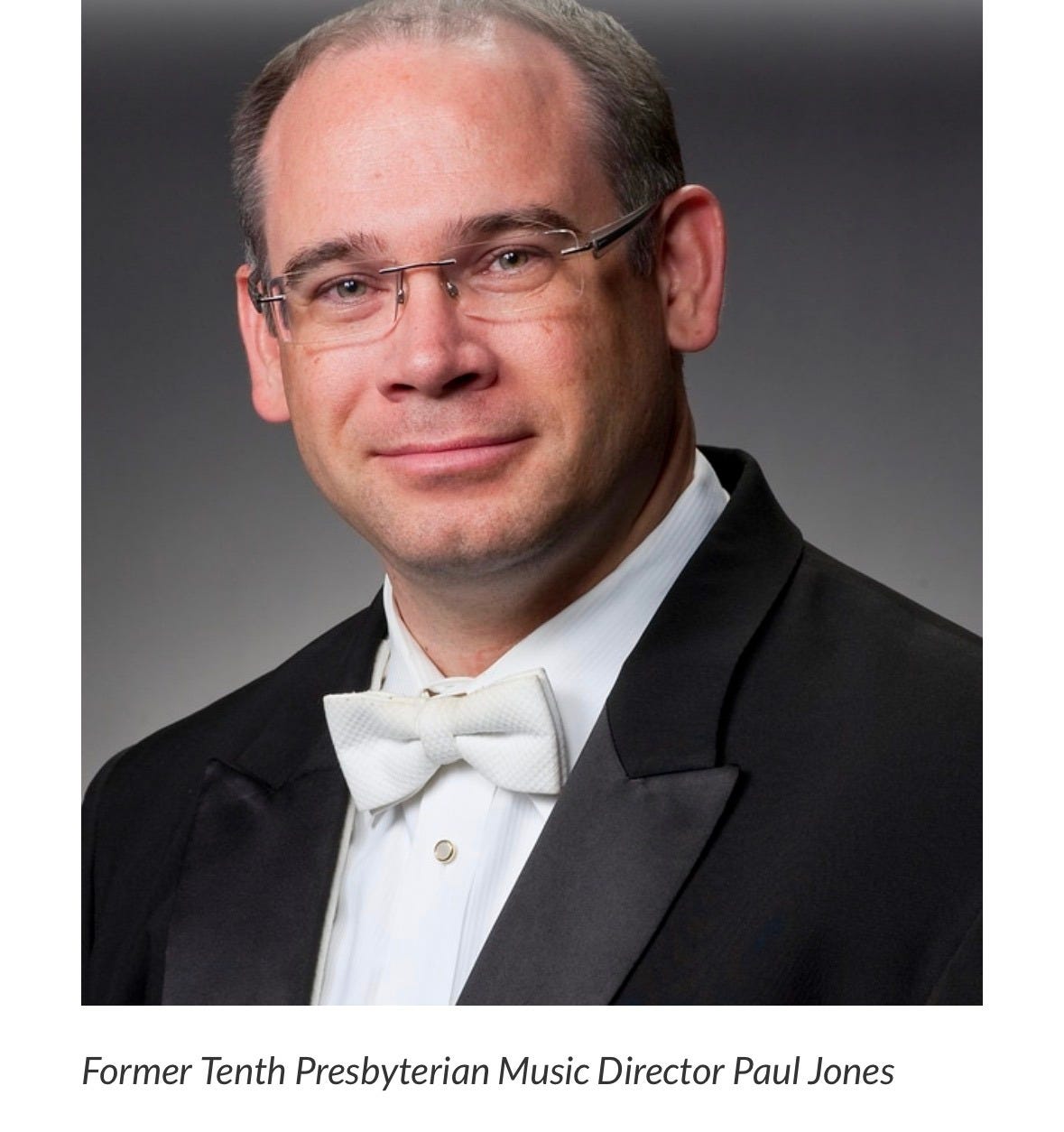
Here is how Silliman describes the victim’s statement:
He told RR that he originally went to Philadelphia Bible to study with Jones. The music director was his teacher and mentor, he said, and beatings were part of the instruction.

As a 19-year-old student, the man told RR, he struggled to learn a particularly complicated piece of music in the allotted time. Jones told him he’d have to be “held accountable,” he said. Then he was instructed to write down everything he was struggling with, including the “sin” of making out with his girlfriend and getting distracted from music practice.

After the man did as he was told, he said, Jones punished him.

“It wasn’t paddling,” the man told RR. “I took down my shorts, naked, knelt down beside the bed, and after reading every single sin, he beat me with a stick, like a stick that you’d use to hold a sliding door closed.”

Jones beat him “to a pulp,” the man recalled.

After the beating, he said, Jones hugged him. Then the student pulled up his underwear and shorts, cleaned himself up in the bathroom, and the two went to lunch, he said.

“I couldn’t walk right for weeks,” he told RR.

The man said Jones told him multiple times that he couldn’t tell anyone about the beating. They would not understand, he said, “how much I love you and how much I want to help you.”
It’s all there: the detailing of sin, the spiritual catechesis, the articulated painful corporal punishment, the reassurance of love. “I do this because I love you,” the confusing message told to millions of children by parents who turned them around and hit their bodies.
I hope you can see it for the physical, sexual, and spiritual abuse it is. It’s not okay when someone does this to a 19 year old, and it’s not okay when someone does it to a toddler or preschooler. I hope you can see the connection. Paul Jones certainly did. He claimed his victim had “asked to be spanked because he was homeschooled, and that’s how he learned from his parents.” I hope you can see that decades of Christians defending and propagating such practices has enabled abuse of all kinds.
Phil Ryken, in his role as then-minister of Tenth Presbyterian Church, apparently accepted Jones’ explanation. He did not reach out to the victim’s family to see if other children in the home were being spanked into their teenaged years. He did not fire Jones. His silence enabled Jones to prey on more victims. Ryken and the elders who assisted him did not speak with the victim or any of the students who worked with Jones. They did not even require Jones to get counseling; they merely recommended it. They did not tell the rest of the elders or the members of the choir Jones oversaw what had happened. They accepted as normative a scenario where a minister abused a student in this way. Phil Ryken, a man who has for years now been entrusted with a community of thousands of college aged young men and women, heard this and thought: fine.
The fallout was incalculable. Silliman describes how an additional victim “figured that what happened to him must be ‘no big deal,” because his church leaders did not act as though it was a big deal. There were at least six more victims that Ryken either never knew about or never documented. Jones allegedly continued to abuse young men, and a separate elder who was also a nursery worker was arrested for sex crimes against minors. The rest of Silliman’s article details the way Tenth continued to cover up what happened and compounded the harm to Jones’ victims. Roys’ series reporting on the way Wheaton College handled disclosures of Dennis Massaro’s abuse spotlights additional patterns.
I’m Angry About Systemic Injustice in Evangelical Communities
It’s almost as though people who have been formed in evangelical communities have been formed to excuse away such behavior. Over the past five years, I’ve witnessed my own denomination, the ACNA, fumble and fail their way through lawyerly word salads and bungled trials and good intentions and victim blaming, all propped up by Good Immature Men and the Compliant Women who still follow the rules. I’m angry about the way our Christian communities continue to fail people; I have been for years. I don’t have much optimism that Wheaton will fare any better, but if you are connected with the college, please don’t look away. There is a petition with action steps here.

I don’t know what it will take for powerful men in evangelical institutions to rend their hearts and not their garments, to seek actionable repentance and not CYA statements, to see that their incompetence, their immaturity, their inability—however you name it—was grievously harmful. In online chatter about this, I’ve already seen some people knee-jerk defend Ryken. But look how much he has done for the College! Look how sad he seems to be! Why are people so mean and tearing down the Church!
It’s an uncanny dynamic that I’ve learned to recognize. In any other employment situation, any one of these failures would be grounds for termination, let alone the lot of them. Stating that fact, pointing out that some things are immediately disqualifying, is not an expression of malice against Phil Ryken. For all I know, he had the best of intentions and did the best he could with the tools he was given (sound familiar?) But that isn’t reason for him to keep his job. That isn’t reason for everyone to gamble that this time he—or the myriad of other Christian leaders who cycle through this same pattern— really get the message, this time they’ll learn that, no, you don’t just believe abusers and send them away quietly, that this time they’ll manage to get up to speed on abuse dynamics, and rates of recurrence, and trauma informed care.
Why in the world do we continue to prioritize the ministry ambitions and career aspirations of men over the vulnerable people entrusted to their care? How many young men have to experience abuse before it’s grounds for termination? How many predators need to be quietly sent along to find other victims? How many bungled abuse responses cross the line? How many second and third and fourth chances do evangelical men get before they finally hear the words: I’m sorry, but this is disqualifying.
Actions—whatever someone intended—have consequences. Acknowledging this, saying “no” to someone is not malicious, it’s not destroying the Church, it’s not mean. At least I’ve been told that all my life as a Christian woman who came of age in evangelical spaces. You feel called to ministry? I’m sorry, but no. You have a gifting in that area? I’m sorry, but no. Insert Bible verse citation here. Generations of Christian women have been swiftly and summarily told their God-ordained gender is disqualifying, while we cannot find the will to tell men whose actions are disqualifying: no. Perhaps we have such a difficult time dismissing unqualified men, because we are out of practice with telling them no. Or perhaps they are unaccustomed to hearing it. I’m not sure, but sometimes the answer just needs to be: no.
No to Ryken, who probably should have been told “no” way back when Tenth Presbyterian first heard about what happened with Jones. No to the decision makers at Wheaton who must have been aware and hired him anyway. No to the trustees and board and anyone else who was aware of Masarro and excused it away. No to the pastors and teachers and preachers and authors who baptize violence in the name of God.
The Good News About Anger
Anger is a God-given emotion that inspires us to action—to protect, to defend, to seek justice. Maybe you need to hear it as much as I do: it’s okay to be angry about abuse in God’s Church, among God’s people, done in God’s name. Let that move you to action, however slow and resistant systems may be to change.
Sometimes people tell me that something I’ve said or written is the first time they’ve ever heard there’s any other way of viewing “The Gospel” besides penal substitutionary atonement. They are curious to learn more and want to know what view I hold. I tend to think all our best theological efforts are only glimpses of something that is multifaceted, like cut angles on a gem that we can never quite see clearly.
But these days I’m drawn most to the Christus Victor theory, to the picture of a God who indeed is angry about sin and all its exponential effects, but that anger doesn’t move Him to inflict more pain on us, as though He is dysregulated and out of control or doesn’t care who gets punished as long as someone hurts. No. For me, the Good News of the Gospel is that God’s anger at sin moves Him to action. He sees our fractured world. He witnesses the incalculable damage we do to ourselves and others. He hears our howls of lament and pain. His rescuing, saving work needs no tortured explanation of why our pain is really His love, or why His wrath is really Good News. We can see for ourselves the Gospel, the “Good News” in action. He comes to set us free, to defeat The Powers of sin and death that have held us all captive from the beginning and continue to steal, kill, and destroy. He comes to put things to right, to bring justice, to wipe away our tears, to become one of us, who Himself is identifiable by the wounds He received as a human. And as we follow and are found in Him, we become agents of this work, too—the Body of Christ sent to bring healing and restoration in a groaning and weeping world. If, as Wheaton taught me, we want to be working “for Christ and His kingdom,” let’s start with that.
*****
Edited to add:
Paul Jones, the abuser Ryken failed to fire at Tenth, has been employed at the University of the Bahamas since 2013…working with students. More here:
And earlier this week, Wheaton sent a letter to faculty/staff. Please read Christy Hemphill’s outstanding analysis of the image management:

Related Reading:


Read what people are saying about The Myth of Good Christian Parenting!
Join me and Kelsey Kramer McGinnis for conversations about the book.

***
Learn more about my novels: Storybound, Story’s End, A Sliver of Stardust, A Legend of Starfire, and The 12 Dares of Christa
Subscriber only courses:
How to Write and Publish a Novel
This is a must-read, about a set of issues that are usually buried and for which massive resistance is too often raised against those who have the courage to speak the truth. I am starting to suspect that the theology is designed as a ticket to power, privilege, and, yes, for men, instead of being a license to serve those without that power as Christ did. If Churchianity actually believed and worked out the myriad of details supporting a world where everyone is created in the Image of God, with neither more of that divine light or less than anyone else, things I think would feel very different. I too went to Wheaton and am so grieved to see the coverup and lack of accountability. The growing exposure and call for accountability is more than encouraging.
I went to seminary after Wheaton before med school in an effort to understand and heal from a childhood where Christianity was used to conceal and justify physical, emotional and sexual abuse, including being beaten with 2x2 inch clubs of lumber. Though the extreme atrocity of what was going on was concealed, I know some adults in the church turned a blind eye.
In my upcoming book, Relationsick: Why Putting Yourself Last is Destroying Your Health - and How to Heal, we discuss among other things a study that I found to be revealing. In an effort to understand the differences between the very small group of people who hid Jews during WWII at great risk to themselves and their families (< 0.1 percent) and the vast majority of those who aided the Nazis, they discovered something striking: one of the main things separating these two groups of people was whether they had been raised with corporal punishment. Those who were raised with empathy and taught to reason about what's right and wrong later, as adults, had more empathy for others who were being mistreated. Those who were raised with indoctrination that the "one with the biggest stick wins" were more likely to aid and abet the Nazis. This is really important to consider as a reflection point, I believe, and is helping me deconstruct really bad theology, teaching, and practices.
The points about anger being a gift from God as a warning sign that a boundary may have been crossed is also critical. A massive topic. In my experience bad teachings were used to anesthetize the spidey senses on the back of my neck so that I wouldn't out the abusers. One problem with this is that one then comes to think of this as love. It feels familiar. In so doing, one comes to believe that safe people are unsafe and safe people are unsafe.
Great writing.
This is an absolute must-read. I hope you’re trying to get published in the NYT because you belong there.